The Twilight Rule: Why Do Experienced Campers Always Turn on Their Camp Lights an Hour Before Sunset?
If you’ve ever gone camping with true outdoor veterans, you’ll notice a curious unspoken agreement: even before the sun has set—while the western sky is still tinged with a pale white—they begin to turn on their camp lights at a leisurely pace. Newcomers often wonder, “Isn’t that a waste of electricity?” On the contrary, it’s an extremely energy-efficient and clever strategy.
1. Seizing the “Golden Visual Window”
When the human eye moves from a bright to a dark environment, it takes at least 20–30 minutes to fully adjust (a process known as dark adaptation). If you wait until it’s completely dark to turn on the lights, you’ll experience an extremely dangerous “semi-blind” state—you won’t be able to see tent stakes clearly, find zippers, or even risk stepping into a hole.
Experienced campers choose to turn on their camp lights while ambient light still provides basic illumination, using this precious “transition period” to allow their eyes to adjust seamlessly to the light. At this point, the contrast between light and dark is minimal, so your pupils don’t need to constrict sharply. By the time night has fully fallen, your eyes will have long since adapted to the brightness of the lights, and everything in the camp will appear clear and unhurried.
2. Give Your Mind a “Sunset Ritual”
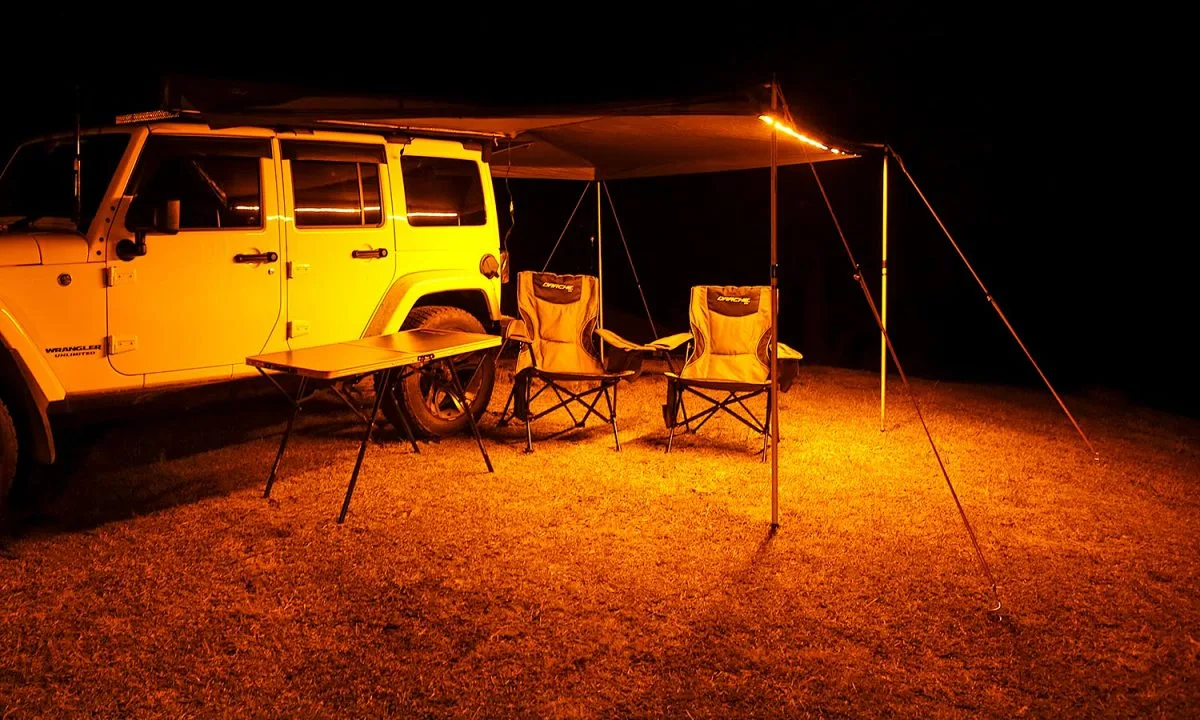
Lighting is not merely physical illumination; it also serves as a psychological “anchor of safety.” Turning on that warm yellow light an hour before sunset is like declaring to the entire campsite: “We’re staying here tonight.” This sense of ritual effectively reduces the anxiety of spending the night in an unfamiliar environment. Especially for beginners camping overnight for the first time, lights turned on early are more effective than any other form of reassurance.
3. Calibrate the Light Color with the Naked Eye
Natural daylight has a cooler color temperature (around 5000K–5500K). When you turn on your lights at dusk, you can use your naked eye to directly judge whether the light has a green or purple tint (a common issue with inexpensive LEDs). Calibrating the light color against a reference point ensures that, when used at night, the light won’t be so odd-looking that it causes errors when reading maps or identifying food colors.
On your next camping trip, try turning on your light while the sunset is still hanging over the ridgeline. You’ll find that this extra hour brings a whole night of peace and confidence.